
Your Home Repair Questions Answered
Vaughn Home Improvement is a licensed chimney services, roof repair, and home maintenance company serving Troy, MI, and surrounding Oakland and Macomb County communities since 1963.
Vaughn Home Improvement has been solving chimney repair, roof leak, and home maintenance problems for homeowners since 1963. Every answer below comes from decades of hands-on experience in Southeast Michigan. If your question is not here, call us, and we will have an answer within five minutes.
Common Questions About Our Chimney and Home Repair Services
How do I know if my chimney is structurally unsafe?
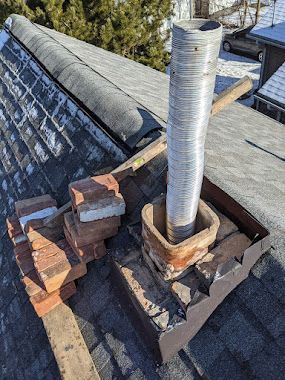
A structurally unsafe chimney shows visible cracks in the exterior masonry, a leaning or tilting stack, crumbling mortar joints, or spalling brick faces. Inside, a damaged flue liner or white efflorescence staining are serious warning signs. If you notice any of these, schedule chimney repair in Troy immediately to prevent collapse or carbon monoxide entry.
Does a cracked chimney crown need full replacement, or can it be repaired?
Most cracked chimney crowns can be repaired rather than fully replaced if the cracking is surface-level and the underlying structure is sound. A professional applies a flexible crown coat sealant that bonds to existing concrete and bridges hairline cracks. Full replacement is necessary only when the crown has heaved, broken apart, or dropped pieces into the firebox.
Do Michigan winters make chimney damage worse between annual inspections?
Yes. Southeast Michigan freeze-thaw cycles accelerate chimney deterioration faster than climates with milder winters. Water enters hairline cracks in mortar or brick, freezes, expands, and widens the crack with each cycle. A small defect noted in the fall inspection can become a serious structural problem by spring if left unaddressed.
What does a chimney rebuild actually involve?
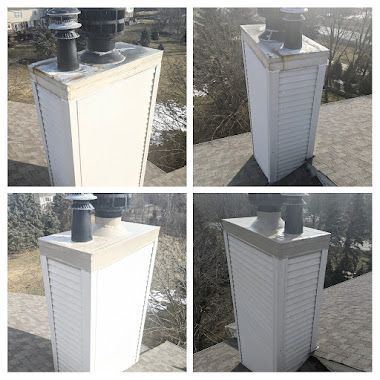
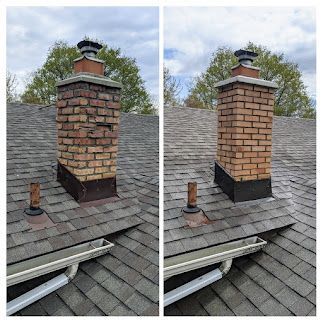
A chimney rebuild involves removing deteriorated brick and mortar above the roofline and relaying the entire above-roof section with new brick, fresh mortar, and a properly pitched crown. The flue liner is inspected or replaced as needed. Rebuilds are warranted when freeze-thaw damage or settling has compromised more than a third of the stack. Our chimney repair in Troy team assesses the scope before any work begins.
How often does a gas fireplace chimney need to be swept?
Gas fireplaces produce less combustion residue than wood, but the chimney or vent still needs an annual inspection and cleaning. Bird nests, debris, and moisture intrusion can block a gas flue just as easily as a wood-burning one. The National Fire Protection Association recommends annual inspection for all fuel types, regardless of how often the fireplace is used.
What is a Level 2 chimney inspection, and when is one required?
A Level 2 chimney inspection is a detailed examination of accessible interior and exterior surfaces, including the attic, crawl space, and basement, using video scanning equipment. It is required when you buy or sell a home, after a chimney fire or earthquake, or when you change fuel type or appliance. Level 1 covers visible areas only; Level 2 goes deeper to find hidden damage.
Do wood-burning inserts need to be cleaned differently than open fireplaces?
Wood-burning inserts burn hotter and more efficiently, which changes how creosote deposits form in the liner. The insert itself must be pulled out to clean the full length of the liner behind it, a step that is not required for open fireplaces. Skipping this step leaves a section of the flue uncleaned and creates a hidden fire hazard that a standard sweep will miss.
What does creosote buildup look like, and why does it matter?
Creosote appears in three stages: a dusty black soot (Stage 1), a flaky or crunchy tar-like coating (Stage 2), and a hard, glossy, tar-glazed deposit (Stage 3). Stage 3 is the most dangerous because it ignites at low temperatures and burns intensely. Even a small amount of Stage 3 creosote inside your flue creates a serious chimney fire risk that cleaning alone cannot always remove.
How can I tell if a ceiling water stain is coming from flashing failure or from the roof deck itself?
Flashing leaks almost always appear at a penetration point, such as where a chimney, skylight, or vent pipe meets the roof. If the stain on your ceiling aligns directly below one of these features, flashing is the likely cause. A stain that appears mid-span, away from any penetrations, points to a failed shingle, a cracked deck, or an ice dam. Our roof leak and flashing repair team can pinpoint the source quickly.
Can step flashing be repaired without tearing off the surrounding shingles?
In many cases, yes. When step flashing has lifted, separated, or corroded at just a few courses, a skilled technician can carefully lift the overlapping shingles, re-seat or replace the damaged flashing sections, and re-nail the shingles without disturbing the rest of the roof. Full shingle removal is necessary only when the damage is widespread or the shingles themselves are brittle and likely to crack during the repair.
How quickly can an unrepaired roof leak cause structural damage?
An active roof leak can cause structural damage within days to weeks depending on leak volume and weather conditions. Water saturates insulation, rots roof decking, and promotes mold growth that can spread to rafters and wall framing within 24 to 48 hours of sustained moisture. A leak that looks minor at the ceiling stain may already be causing hidden damage above. Contact us to request a free estimate before the next rain.
What is the difference between tuckpointing and repointing?
Repointing means removing deteriorated mortar and replacing it with fresh mortar that matches the existing joint in color and profile. Tuckpointing is a specific technique where two different-colored mortars are used: a background mortar that blends with the brick face and a narrow contrasting ribbon applied along the center to create the illusion of fine, tight joints. Both processes strengthen masonry, but tuckpointing is primarily a finishing aesthetic technique.
Can crumbling mortar joints be repaired during a Michigan winter?
Mortar requires temperatures above 40 degrees Fahrenheit during application and curing, making most Michigan winter months unsuitable for masonry repair. Applying mortar in freezing conditions causes premature curing failure and pop-out within a season. We recommend scheduling tuckpointing in late spring through early fall to ensure a proper bond that will hold up through years of freeze-thaw cycles.
How long does tuckpointing typically last on a home in Troy, Michigan?
Quality tuckpointing lasts 20 to 30 years on a Troy, Michigan, home when performed with properly mixed mortar matched to the original joint hardness. Using mortar that is too hard for older soft brick accelerates spalling and can shorten results to under a decade. Vaughn Home Improvement selects mortar mix by brick type and age, not by convenience, which is why our work holds up through Michigan winters without cracking.
What makes seamless gutters better than sectional gutters for a Michigan home?
Seamless gutters are formed from a single continuous run of aluminum cut to the exact length of your roofline, eliminating the seam joints where sectional gutters most often leak. In Michigan, where gutters handle heavy spring rains and ice dam runoff, seam failures are the primary cause of gutter water damage at the fascia and foundation. Fewer joints mean fewer leak points and a longer service life for the entire drainage system.
Should gutters pulling away from the fascia be replaced entirely, or can they be rehunged?
Gutters that are pulling away from the fascia can often be re-hung if the fascia board itself is solid and the gutter channel is not bent or corroded. We replace the existing hangers with longer hidden hanger screws that bite further into the rafter tails, providing a far more secure hold than the original spike-and-ferrule fasteners. If the fascia is rotted or the gutter is damaged, full replacement is the more cost-effective long-term solution.
What gutter guard options work best during Michigan leaf-drop seasons?
Micro-mesh gutter guards perform best in Michigan because they block both large oak and maple leaves and the fine debris, seed pods, and helicopter keys that pass through standard screen guards. Surface-tension helmet-style guards tend to overshoot water in heavy Michigan downpours. We recommend pairing micro-mesh guards with our seamless gutter installation for a system that handles Michigan's full four-season weather without clogging or overflow.
Ready to Schedule Your Free Estimate
Reach out today, and we will get you a fast, honest estimate on any chimney repair, roof leak, or home maintenance service.




